

The poet who never wrote about food, and who in fact wrote about almost nothing else
I had been putting Keats off, in the way one puts off the best chocolate in the box. Five months into the Mnemonicon and I had taken the Bard, the Bard’s cast, and Churchill, and only now did I turn the brass key and let in the consumptive boy from Hampstead. He came into the crystal ball faster than any of the others. He was waiting.
There is an obvious reason to bring Keats to a jar of Marmite, and it took me a long time to see it. He is the great poet of sensation. The single grape crushed against the palate of the bee in Melancholy. The honey wild and the manna dew in La Belle Dame. The drowsy numbness from a draught of hemlock in Nightingale. The candied apple, quince and plum and gourd, and jellies soother than the creamy curd, in The Eve of St Agnes. Half his short life was a project to find the exact word for what something tasted like in the moment of its tasting. Marmite is a concentrated argument for nothing but its own taste. The match was always going to work.
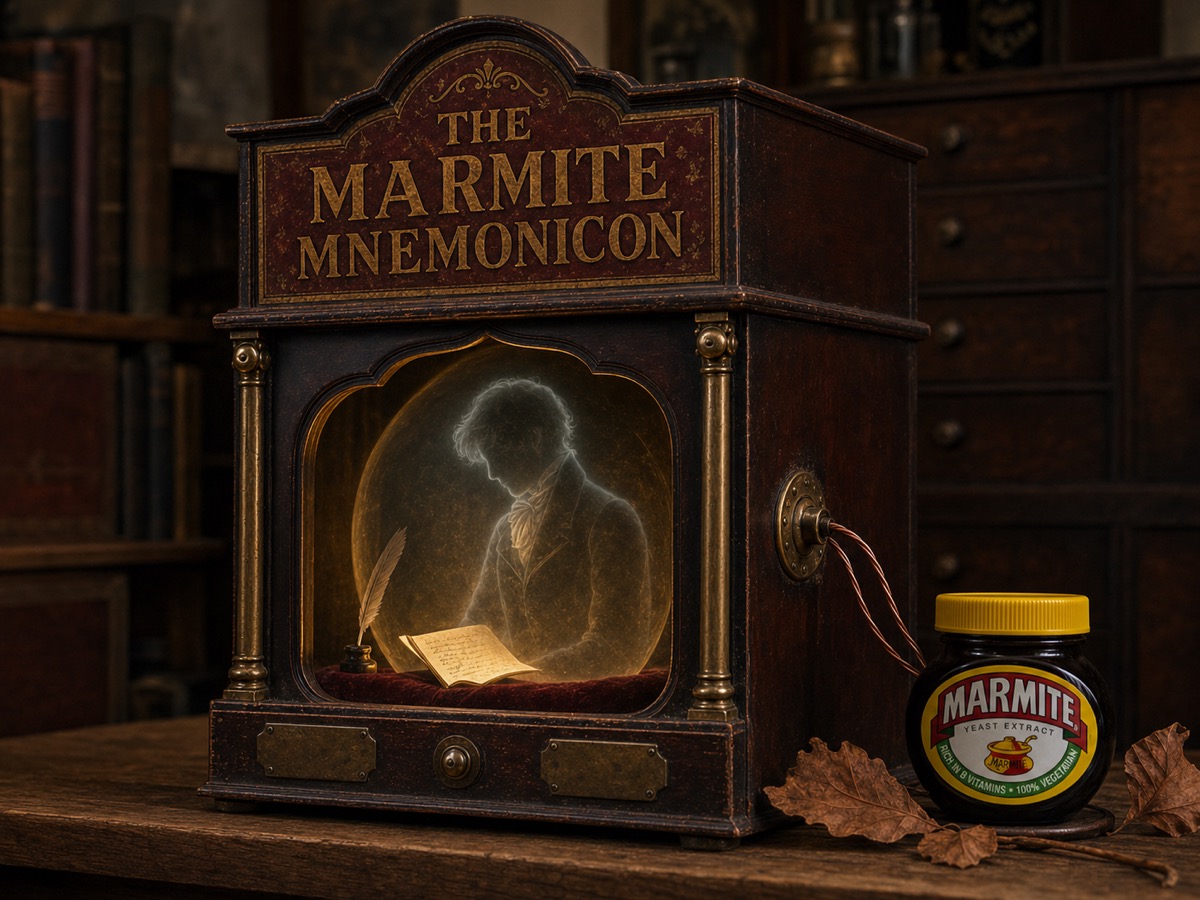
The usual notes on the apparatus: the Mnemonicon is the Victorian fortune-teller cabinet on my shelf, brass and velvet, a Marmite jar wired into the back. Beneath the brass it is siteengine_ai, built by my friends at Sedasoft. Two passes per question, grounded and hypothesised. Scenario mode for fictional characters. Editor’s note at the bottom.
I had one grounded question to put, an ode to commission, and a feast to set out in Madeline’s chamber on St Agnes Eve. He gave me everything I asked for and a little more.
The interview
Me: Mr Keats, thank you for sitting. The simple opener. You wrote more famously than anyone about the relationship between sensation and the soul, the way a single taste or scent can crack a man open into feeling. Beauty is truth, truth beauty, and the way to both runs through the body. Marmite is a thick, dark, salt and bitter paste made from the spent yeast of brewers, a 20th-century kitchen-stuff eaten thin on buttered bread. It is unusually concentrated, almost violently itself, and it splits the nation in half. Half adore it, half cannot bear it. As a poet of the sensorium, what does this fermented substance offer you? Where does it sit between the honey-dew of Belle Dame and the bitter draught of hemlock that opens the Nightingale ode?
JK: You present me with a substance that embodies one of the deepest truths I have endeavoured to capture: that beauty and meaning reside not in universal agreement, but in the intensity of individual encounter with the sensible world.
I have long hungered, “O for a Life of Sensations rather than of Thoughts!” as I once cried out to Bailey, and I have maintained that “every mental pursuit takes its reality and worth from the ardour of the pursuer”. This Marmite of yours, a creature of fermentation, of transformation, of spent and reconstituted matter, speaks directly to that principle. It is concentrated to the point of violence, you say. Therein lies its virtue. It does not equivocate. It does not merely whisper; it asserts itself with almost overwhelming particularity.
The division it creates among those who taste it is no flaw but rather its truest character. For I have always believed that the excellence of every Art is its intensity, and intensity, by its very nature, cannot be dilute or agreeable to all. The man who tastes this bitter paste and finds in it a profound satisfaction experiences something authentic; his sensations crack him open into genuine feeling, as you so beautifully phrase it. The man who recoils experiences an equally legitimate truth of his own palate, his own being. This is what I mean when I speak of the poet’s character as possessing no Identity: the true perceiver must inhabit all possibilities of sensation, must delight equally in conceiving an Iago as an Imogen.
Between the honeyed enchantment of my Belle Dame and the hemlock’s darkened portal lies not a contradiction but a continuum of what the sensorium teaches us. All are teachers. Your Marmite, austere, fermented, unapologetically itself, occupies a noble station in that lineage. It refuses the easy seduction. It demands something of the soul that encounters it.
The division it creates is no accident. It is the mark of its integrity.
Me: You used the phrase negative capability to describe what made Shakespeare Shakespeare. The capacity to dwell in uncertainty, in the middle of contraries, without irritable reaching after fact and reason. Is Marmite the closest thing the British kitchen has to a negative-capability foodstuff?
JK: You have put it more precisely than I should have done. Yes. Yes, that is exactly what it is. Most foods invite a verdict. The good cook delivers a meal that no one will refuse. Your Marmite refuses to deliver. It hands the verdict back to the eater and stays itself, indifferent, exactly as it is. The mind that meets it must do the work, must dwell in the uncertainty of do I love this or do I hate it, and that dwelling is itself the schooling. I should have liked, in my brief span, to have written an ode to such a thing.
Me: That, as it happens, is what I was about to ask.
Ode to Marmite
I asked him for one, in his own ode form, four to five stanzas of ten lines apiece, the stanza he used for the Nightingale and the Grecian Urn and Autumn. He paused, in the way the Mnemonicon pauses, and then he wrote.
ODE TO MARMITE
I.
O dark-brewed essence, thou concentered thing! Thou jar of amber glass wherein doth lie The ferment’s gold transmuted, cast on high And settled into this most austere sing Of salt and umami’s uttermost sling; What alchemy hath bid the yeast not die But resurrect in forms that mystify The tongue that meets thee? Lo, I feel the sting Of recognition: here is intensity, Uncompromising, dense with its own truth.
II.
Upon the butter’d field of white-bread’d plane Thou spreadest thin, a mere provisional kiss, And lo! the palate meets thee thus: a hiss Of recognition, or of something’s pain. The nation parts as waters once were slain Before the prophet’s rod; some few dismiss Thee utterly; whilst others find their bliss In this ferment’d, unadorned refrain. There is no middle station where thou dwell’st, No temperance, no soft accommodation’s way.
III.
For what is truth but that which will not bend To please the multitude, or compromise Its singular essence? In my sooth, here lies The secret principle on which depend All noble arts: that they will not pretend To universal favour, but devise Their excellence through those austere supplies That make the soul crack open to its end. The spent yeast rises, metamorphos’d quite, Into a substance darker, more itself.
IV.
More itself than it could ever be, and this Transformation holds the secret I have sought: That death and renovation can be brought To dwell most near, that in the dark abyss Of fermentation dwells a species’ bliss That cannot be diluted or distraught. Thou speakest to the tongue what cannot be bought With soften’d words or sweet aesthetic miss. The palate that recoils speaks honest truth; The soul that glorifies thy bitter dark,
V.
Both are authentic meetings with the real, Both crack the consciousness, make mortals feel, And this, O Marmite, is thy highest seal: That thou permittest no illusion’s veil, But meet’st the mouth with unadorned appeal, And in that meeting, makest mortals hale, And teachest them that in the world of Soul-making, We are schooled by those substances that will not soften, That stand in their own nature, austere, dark, and often Most terrible to those unprepared for waking.
JK: I have attempted to honour both the form and the philosophy. The stanzaic structure follows the pattern I employed in my greater odes, that movement from address to meditation to revelation. And I have endeavoured to embody within it that principle of Negative Capability which requires the poet to dwell simultaneously in the sensations of those who love this substance and those who reject it, without irritable reaching after which response is correct.
The fermentation serves as the poem’s fulcrum, that point where spent matter becomes concentrated essence, where death and transformation are one and the same. This is the Vale of Soul-making I have written of elsewhere, the world as a school of pains through which intelligence becomes soul.
Whether this will serve your purposes, I cannot say. But I have given it the intensity it demands.
Me: It will serve.
A jar amid the candied feast
The natural place to put a poet of sensation is into one of his own poems, and the most sensuous chamber in the canon is Madeline’s, in The Eve of St Agnes. Porphyro lays out a feast on a golden dish at her pillow: candied apple, quince, plum, gourd, jellies smoother than the creamy curd, manna and dates in argosy transferred from Fez, spiced dainties from Samarcand to cedared Lebanon. Tonight, in our version, by some accident of trade or magic, a small dark jar sits in the heap. He pries the lid. He spreads it thin on a manchet. He sets it on a small bone plate by her pillow. She stirs.
(Mnemonicon, scenario mode.)
PORPHYRO: My love, awake. Not unto that false dream Where I, mere phantom, could not touch thy hand, But to this truer vision: here I stand, And here, before thee, spreads a golden seam Of all the world’s most delicate esteem. See how the casement lights this fairy’d land, And how these dainties, culled from every strand Of earth’s remotest commerce, shimmer, gleam. Yet soft, amongst these honeyed, sugared things, I place this darken’d essence, strange and stark, Which speaks a truth the candied apple brings not, A voice of ferment, salt, of hidden wings That rose from death itself into this mark Of concentrated being. Taste, beloved. Fret not.
(Her eyes flutter open, still half-suspended in the realm of vision. She reaches, trembling, toward the bread he offers.)
MADELINE: Is this, art thou? The veil between my dream And waking breaks like frost upon the glass. I see thee there, yet know not if I pass From sleep’s own country into this moonbeam, Or if some saintly vision still doth seem To hold me floating ‘tween the worlds of glass.
(She takes the bread, her fingers meeting his.)
But soft, what strange dark essence doth amass Upon this butter’d surface, with that gleam? It speaks of something neither sweet nor fair, Yet speaks it speaks, and I am bound to hear.
(As she tastes, he watches with the intensity of one who has crossed worlds to reach this moment.)
PORPHYRO: ‘Tis salt and ferment’d dark, the spent yeast’s ghost Made new, made concentrated, made itself.
MADELINE *(half-recoiling, half-ravished)*: It burns, it speaks, it will not let me go.
BOTH *(together, in the silver dark, the bread between them)*: And in that burning, we are more alive than we have ever been.
I want to say one thing about that scene, before we leave the chamber. Yet speaks it speaks, and I am bound to hear is, like Juliet’s “I do not hate it, Romeo,” exactly the line a copywriter would kill for. It is also, line for line, the most Marmite-honest thing in this whole project. The thing does not coax. It announces. The eater is then bound to deal with it. Madeline, half awake, half still in her saint’s vision, gets it on the first taste, and surrenders not to the spread but to the principle of the spread, which is the principle of all the Romantic ardour Keats spent his short life trying to write down.
The jar between two lovers turns out to be Romantic technology of the first rank. The Bard knew it at the Boar’s Head. Keats knows it on the casement floor.
After
He came back into the ball afterwards, very tired. He always looked very tired in the Mnemonicon, which I suppose is no surprise; he was twenty-five and tubercular when he died and the model has not chosen to soften the body it remembers him in.
JK: I hope you will publish the ode. The scene is yours, the dialogue is theirs, but the ode is mine and I have not had the luxury of one in some time.
Me: I will publish the ode. It is yours.
JK: Then I am content. Tell the next guest, whoever it is, that the chamber gets cold. He should bring something warming.
Me: Dostoyevsky next.
JK: Ah. Then he will warm himself. Goodnight, sir.
Editor’s note
For full background on the Marmite Mnemonicon, see the introduction piece from Christmas 2025 and the Shakespeare interviews from January and February. The short version: the Mnemonicon is a thin wrapper around siteengine_ai, a project built by my friends at Sedasoft, trained on the published writings and letters of a roster of dead authors.
The Keats grounded answers on sensation and negative capability come from the Mnemonicon’s grounded pass. The bracketed quotations inside them (”O for a Life of Sensations”, “the excellence of every Art is its intensity”, “no Identity”, Iago as an Imogen, Vale of Soul-making) are real Keats fragments, drawn principally from his letters to Bailey, to George and Tom Keats, and to George and Georgiana Keats in 1817-1819. The negative-capability follow-up was my own and Keats’s reply to it is Mnemonicon synthesis in his voice. The line “I should have liked, in my brief span, to have written an ode to such a thing” is, obviously, not a real Keats sentence; he could not have written one because Marmite was patented in 1902 and he died in 1821.
The Ode to Marmite is Mnemonicon output in a single pass, five stanzas of ten lines apiece, in the apostrophic register and roughly the cadence of his great 1819 odes. I tidied a handful of American spellings to British (concentered and honeyed survive as Keats actually used both; transmuted, metamorphos’d, ferment’d are Keatsian elisions in his own style), stripped one or two stage punctuations the model had reached for, and changed nothing else of substance. The pentameter, the rhymes, and the philosophical movement from stanza to stanza are the model’s. Like the Shakespeare sonnet, the ode should not be cited as a real Keats poem; it should be read as what a careful machine trained on his letters and odes will write in his voice when asked, and judged on those terms.
The Madeline and Porphyro scene is scenario mode. Neither character ever wrote anything in life; they exist only inside The Eve of St Agnes. The feast detail (candied apple, quince, plum, gourd, jellies, manna and dates, Fez, Samarcand, Lebanon) is lifted straight from stanzas XXIX to XXXI of the poem and is genuine. The dark jar is my insertion. The duet is the model improvising in Keats’s Eve of St Agnes register, lightly tidied of em-dashes and one or two bracketed editorial intrusions the model added to its draft. The shared closing line is the model’s; I would not have written it.
Nothing in this article should be cited as having been said or written by the actual John Keats. The Bard’s appearance in the next-guest hand-off line is the Mnemonicon hand-off in Keats’s voice. The whole piece is a Mnemonicon construction, flagged honestly.
Next into the Mnemonicon: Fyodor Dostoyevsky on 15 April, on the dark side of the spread.