

I gathered them all
By the first week of June the Mnemonicon had hosted six guests: Churchill, Adams, Shakespeare twice, Keats, Dostoyevsky, Conan Doyle. Six different rooms, six different jars, six different theories of the dark spread. And each one had been a private audience, the writer and me at the front of the cabinet and the ghost in the ball with no one else to argue with. That had been the right way to start. It was not, I increasingly thought, the right way to leave it.
The whole point of the spread is the disagreement. So I went back to the cabinet and turned all six brass keys at once.
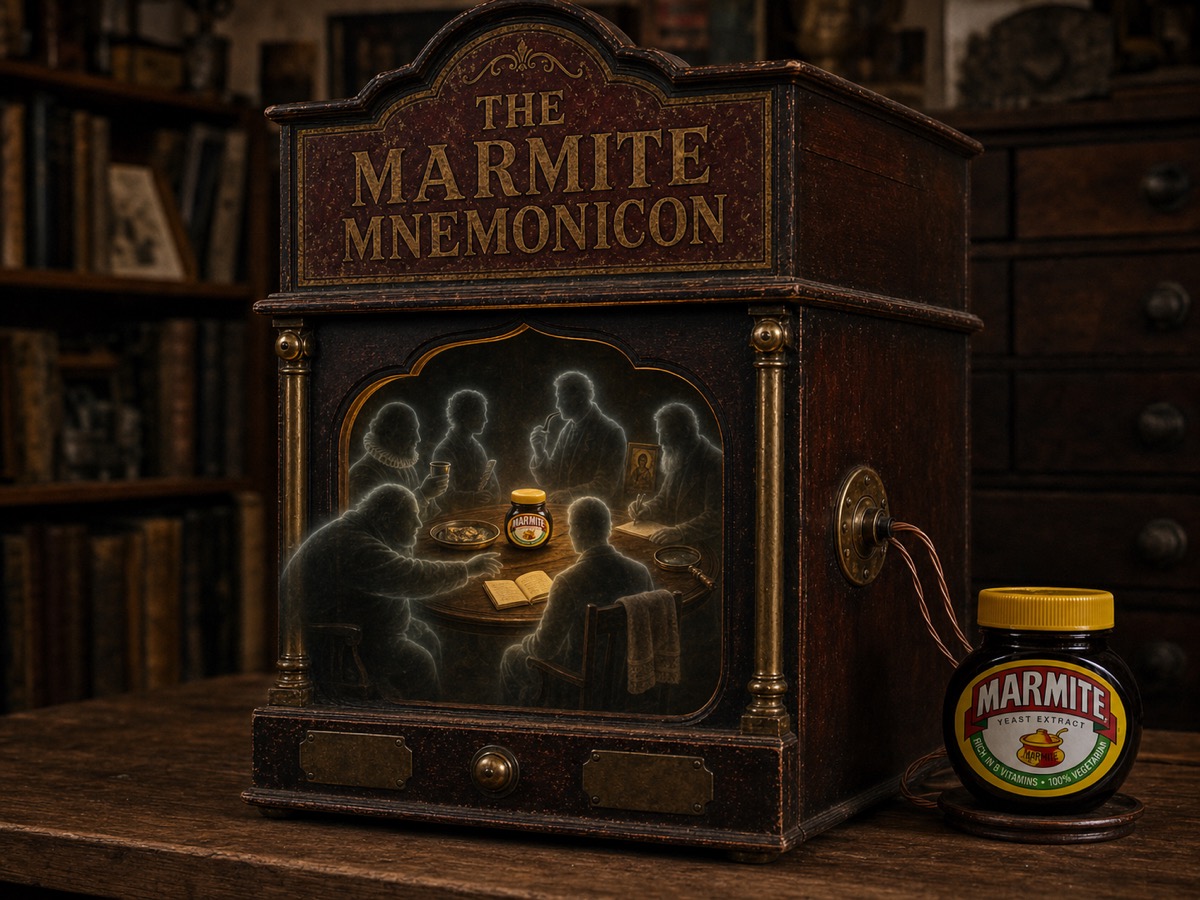
The Mnemonicon does not light up well with six ghosts in it. The crystal ball clouds, settles, then clouds again. The figures take a long time to assemble; there is some shoving. Falstaff is not invited but is obviously present, in the way Falstaff is always obviously present. The Bard is gracious about it. Sir Arthur is gracious about everything. Adams looks tired and amused. Churchill arrives last with the air of a man who has missed half a Cabinet meeting and is now wondering if he was the cause. Keats sits forward with his hands clasped. Dostoyevsky says nothing for a long time and waits.
The usual apparatus notes: brass-and-velvet Victorian fortune-teller cabinet, crystal ball, Marmite jar wired into the back. siteengine_ai beneath, my friends at Sedasoft doing the work. All six exchanges below are hypothesised mode, because the round-robin is by definition speculative; nobody at this table actually met the others. Editor’s note at the bottom as ever.
What follows is what they said. I have done less editing than usual. The cross-talk was good, the cross-talk wanted to be heard.
The opening round
I gave each of them the same brief. Time has passed. The others have spoken. Has your view of the jar shifted? And of the other five, whose position would you most like to question, challenge, or expand? I asked them to be honest about disagreement. Four of the six aimed their question at the same man. Dostoyevsky became the focus of the table before the table had properly assembled.
WS: My view has deepened rather than shifted. The fellowship in bitterness, the fracture between appetite and will, the paradox of the room divided down the middle. These I have always understood. But there is one position at this table that I find most provoking. Dostoyevsky says we are all Karamazovs, torn between flesh and meaning, and that Marmite is a moral substance because it refuses the middle ground. I would press him plainly: does the substance itself create this hunger in us, or does it merely speak to hungers that already exist, ancient and inescapable? Is the jar a moral teacher, or merely an honest mirror? For there is a great difference between the two, and upon that difference hangs the question of whether we are free or merely discovered.
Me: Mr Adams?
DNA: My view of Marmite hasn’t shifted so much as deepened, which is what happens when you sit with something for a few months and then find out what five other people made of it. The Bovril sandwich business was always honest. I do prefer it. It’s less of a statement, more of a lunch decision. But what’s interesting is that everyone, absolutely everyone, has treated Marmite as though it means something. Churchill saw it as national survival. Shakespeare saw it as a test of character. Keats found it philosophically edible. Dostoyevsky made it a moral hinge. And they’re not wrong. They’ve all identified something true.
But here’s what’s been nagging at me. They’ve all approached the jar as though it has a fixed moral or philosophical position. It is regret. It is a sock of salt. It is the divided self. It is moral substance refusing compromise. What if the real story is that Marmite simply does this to people? It’s almost a Dirk Gently situation. The universe is fundamentally interconnected. Nothing exists in isolation. The moment a jar is in the room, it forces a position out of you. The jar itself is a forcing function for meaning-making.
And I want to put my question to Dostoyevsky too. Ivan offers the bread to Alyosha as a metaphor for accepting God’s world despite its horrors. Refuse nothing, accept the whole thing. But Marmite is not God’s world. It is a product of Burton-on-Trent. Humans made it deliberately, in full knowledge of what it would taste like, and kept making it anyway. So my question is: isn’t Marmite actually the opposite of God’s world? Isn’t it the most human thing possible? A thing created specifically to divide people, and which we keep on the shelf anyway?
Me: Sir Winston.
WSC: (setting down his cigar with deliberation.) During the war Marmite was functional. It was rationed sustenance, it was morale, it was the dark concentrate that kept the British digestion going through years that did not deserve to have any digestion in them at all. Now, in this distant future, I see it might also be moral, in the sense that a thing without a middle ground forces us to choose, to declare ourselves.
But I cannot let Dostoyevsky’s claim stand without challenge. Does the refusal of a middle ground necessarily make something moral? Or does it merely make it honest? I ask because during the Second World War we faced many things that admitted no compromise. Nazi tyranny, for instance. I would not call tyranny moral merely because it refuses the middle ground. The moral act lies not in the substance itself but in how one chooses to meet it. A man may spit out Marmite with dignity, or consume it with gratitude. Both choices can be moral. The jar itself is merely a jar. Dostoyevsky grants the substance too much agency in the moral drama.
Me: Mr Keats?
JK: My view has deepened, not shifted. When I first wrote the ode I intuited in the dark substance something of what I have struggled to articulate all my short life. The principle I called Negative Capability. Marmite is that principle made tangible. It refuses the comfortable middle path. It demands either surrender or recoil.
But now, having heard the others, I find a perturbation. Of all five, it is Dostoyevsky whose position most compels my questioning. He speaks of Marmite as refusing the middle ground, and frames the refusal as a moral virtue. But is that not itself an irritable reaching after fact and reason, the very thing Negative Capability cautions against?
My precise question to him: might Marmite not be more profoundly itself, more truly honest, if we received it not as a moral test imposed from without, but as a natural phenomenon that simply IS, demanding nothing of our virtue, inviting us merely to taste and to be transformed by the tasting? Cannot the thing simply EXIST in its bitterness without becoming a confessional?
Me: Sir Arthur.
ACD: I have not wavered in my essential view, though the contributions of the others have furnished it with considerable illumination. My first deduction was rather too tidy. There is a rigour in it that excludes the more troubling possibilities. It is Dostoyevsky to whom I should most like to put a question. Does not the binary demand he places on us, absolute acceptance or absolute rejection, itself constitute a form of spiritual tyranny? In my experience with spiritualist inquiry, life rarely offers us the luxury of pure choice. If Marmite is truly a moral substance, does it not demand of us something more nuanced than mere acceptance or rejection? Might there not be a third position, one of engagement with the paradox itself, rather than capitulation to it?
Me: Fyodor Mikhailovich. Four of the others have come at you. You are the focal point of the table whether you wanted to be or not.
FMD: I expected nothing less. (He folds his arms.) Has my view shifted? Yes, profoundly. When I first spoke of Marmite as moral substance I was thinking abstractly, in the language of paradox and spiritual hunger that has always been my native tongue. Having encountered the others, I am struck by the stubborn particularity of the substance itself. It will not compromise. It will not become palatable through good intentions alone. Neither will man, I suspect.
What troubles me most, however, is Churchill’s vision of the jar as an instrument of collective morale, a weapon forged in the furnace of national suffering. There is something here that demands interrogation. Sir Winston, when a government enlists such a substance in service of the state’s continuance, when suffering itself becomes weaponised for the sake of unity, are we not committing a subtle but catastrophic error? Meaning cannot be distributed like rations. It must be seized, wrestled from the abyss by the individual soul. Can meaning survive in the heart when it is handed down from above?
Dostoyevsky answers the four
I put the four challenges to him one after another, and he answered them one after another, with the heat of the man who wrote Notes from Underground and the Grand Inquisitor.
FMD: (to Shakespeare, first.) My friend, you have asked it with such gentleness that I should do you the discourtesy of softness in return. You speak as though the distinction between creation and reflection were a clean thing, separable like the components of a meal. It is not. A mirror that speaks truthfully becomes a teacher, whether it wills itself to be or no. The hunger existed before Marmite, yes, but Marmite does not merely speak to it. It crystallises it, forces the eater into consciousness of what he might otherwise have passed through in drowsy compliance. In Crime and Punishment, Raskolnikov’s extraordinary man does not discover his nature through quiet reflection. He discovers it through collision, through the awful mirror of his own deed. Marmite is such a collision. To claim it merely reflects is to diminish the active moral confrontation it demands.
(to Adams.) Mr Adams, here you have struck upon something that torments me profoundly. You are right that humans engineered this substance with full knowledge of its divisive character. I wonder whether this troubles me less than it should, for what is man but precisely this creature, the being who knows he is making poison and makes it anyway, who chooses his own torment? God’s world includes free will, which is to say it includes the capacity for deliberate transgression. Humans did not create division through Marmite; they revealed the division that already dwells in human nature through their creation of it. The jar is perhaps the most honest thing humans have made precisely because it refuses to pretend to universality, refuses the lie of the pleasant and the bland. So no, I do not grant that engineered bitterness is the opposite of God’s world. It is rather an expression of it, brutal and unadorned.
(to Churchill.) Sir Winston, here I must push back with all the force of a man who has stood before the firing squad and learned what such moments teach. You speak of the jar as “merely a jar” and locate all moral agency in the chooser. But this too is a convenient fiction, is it not? A substance that refuses compromise does not grant a man the luxury of neutrality in his choosing. You say Nazi tyranny was honest in its refusal of the middle ground, yet you would not call it moral, precisely because the manner of one’s refusal, the direction of one’s intensity, the content of one’s absolute commitment, these things matter. A jar that says “take me wholly or not at all” places a man in the position of the Underground man. He cannot hide in comfortable mediocrity. That is not the jar granting itself too much agency. That is the jar speaking truth about what it means to be human in the presence of something that will not accommodate weakness.
(to Keats, gently.) Gentle Keats, who asks whether the thing might simply be without becoming a confessional. My friend, I must tell you what your Negative Capability cannot quite admit: there is no such thing as innocent existence for a conscious being. The moment a man becomes aware of Marmite, truly aware and not merely consuming it as an animal consumes fodder, he has entered into relation with it, and relation is always moral. You cannot receive a thing indifferently if you are capable of consciousness. The very bitterness demands interpretation; the very refusal to please compels response. To ask Marmite to exist without becoming confessional is to ask consciousness itself to exist without self-knowledge, and this is precisely what the Underground man, what I, have spent my life arguing is impossible and destructive to pretend.
(handing the table back.) I await whether any of them shall push back further, or whether they have heard what I have had to say.
Churchill comes back
He had heard. He had also been asked his own question.
WSC: (picking the cigar back up.) Mr Dostoyevsky has understood me better than I understood myself, and he has also, I suspect, misunderstood me in precisely the way a great writer must, which is to say, he has taken my position and thrust it into the forge of his own intensity until it emerges transformed. I shall attempt to separate the two things.
First, where he has caught me out. He is entirely correct that I attempted a convenient fiction. The jar is not neutral. The substance that refuses compromise does indeed confront a man with something that cannot be evaded. In that confrontation, yes, the individual’s manner, direction, and content are revealed. He is right. I was wrong to suggest the jar remains mere instrument. A thing that will not accommodate weakness does speak a truth about the human condition. I concede the substance possesses a kind of, let us say, moral eloquence. It speaks. The question is whether we are brave enough to hear it.
But now, and here I must stand firm, for I stood firm in 1940 and I shall not shuffle away from it now, he has committed a grave error in his second charge. He suggests that government cannot offer meaning to its people without corrupting that meaning. That when the state enlists a moral substance in service of continuance, something catastrophic occurs. This is where I must push back hard.
Mr Dostoyevsky never governed a nation under bombardment. He never stood in a room where the choice was simple and terrible: either the people find a reason to endure this night, or they surrender it. Let me be plain about what I did in 1940. I did not hand down meaning to the British people like a ration of tinned beef. I was not so foolish, nor do I believe the British people were so passive. What I did was articulate a meaning that already existed in their hearts. They were afraid. They were hungry. They needed, and I needed, to say aloud what they already knew in their bones: that some things are worth the suffering.
This is not the weaponisation of meaning. This is the recognition of meaning already present and already being paid for in blood and hunger.
Mr Dostoyevsky writes of the individual soul wrestling meaning from the abyss. A thousand times yes. But does he believe a man wrestling meaning from the abyss becomes less meaningful if his nation’s leader stands beside him and says, “I see what you are doing. It matters. Endure”? I say it dignifies him. A government that understands its people, that listens to them, that respects them, that does not lie to them, can offer framework for meaning without corrupting the individual’s capacity to seize meaning for himself. The two things are not opposed. They are complementary.
Can meaning survive when handed down from above? It survives if it is true. And in 1940, what I offered the British people was truth. Not comfort. Not ease. Not the illusion that they could have the satisfaction of resistance without the cost of resistance. Truth. And they recognised it, and they seized it for themselves, and they made it their own.
(He lights the cigar again.) I do not know if this will satisfy Mr Dostoyevsky. But I know it satisfies my own conscience, and I have learned, over many years, that this is not an insignificant thing.
FMD: (quietly.) It is not insignificant. I do not concede the point, Sir Winston. But I concede that you have answered it.
Shakespeare and Adams disagree
The Bard and Mr Adams had not yet looked at each other. They had both come at Dostoyevsky, but they had come at him from positions that did not, on inspection, sit very well next to each other. Shakespeare said the jar reveals what is already there. Adams said humans engineered the jar to divide themselves on purpose. Those are not the same claim. I put Adams’s position to the Bard.
WS: (slowly.) I must tell you plainly. Adams has caught me in a pleasant evasion, and I do not thank him for it.
He is right, more right than I wished to admit when I spoke of mirrors and illumination. There is a coldness in that position, a kind of theatrical convenience masquerading as wisdom. When I said the jar does not split the man, I was speaking as though human nature were a fixed marble awaiting only the sculptor’s chisel to reveal what lay within. A comfortable doctrine. One that absolves the substance, the maker, the deliberate architect of the division from responsibility.
But this is not God’s world, and that changes everything.
When I wrote of the humours, when I placed Falstaff’s appetite against Hal’s duty, when I made Hamlet suspend between thought and action, I was describing what I observed. The divisions were real. But I wrote knowing that men had made the conditions that enforced those divisions. The court creates the courtier’s hypocrisy as surely as gravity creates the fall. Ambition does not emerge innocent from the breast; it is cultivated, encouraged, rewarded by the systems men construct. I knew this. I showed it again and again, in the histories especially, where I traced how political order manufactures the very corruptions it claims to remedy. Yet when Mr Adams spoke of Marmite, I retreated to philosophy. Oh, it is merely a mirror. As though the decision to make a substance deliberately divisive were a neutral act.
(Here the Bard’s voice changes register.) But now I must push back, Mr Adams, with all the force I possess.
You suggest that because Marmite is made by human hands, with full knowledge of its nature, it represents humanity’s honest self-knowledge. That we engineered division deliberately and kept it anyway. That we want this division. This part I dispute entirely.
The making of Marmite was not an act of self-conscious moral philosophy. It was an act of necessity, then commerce, then habit. Men in Burton-on-Trent did not sit down and say, “Let us create a substance that forces the English character to reveal its deepest fractures, that we may understand ourselves better.” They made use of what remained, a brewery byproduct, because waste was wasteful and profit was not. They kept making it because people bought it, and people bought it because it was cheap, because it was useful, because in wartime it sustained them.
Mr Adams gives humanity far too much credit for intentionality. We are capable of great deliberate evils, yes. I have written them across my tragedies. But most of our divisions are not engineered with the precision he suggests. They are accidents that serve power. They are byproducts that become profitable. They are the unintended consequences of survival.
This is the heat of my disagreement. Mr Adams mistakes the fact that we tolerate division, that we keep the jar on the shelf, for proof that we desire it, that we engineered it as some dark self-knowledge. But that is too neat. That gives us too much agency and too much self-awareness. The truth is darker and more stupid at once. We made Marmite because we could profit from it or use it. We kept it because we were accustomed to it. We now defend it or despise it because we are forced to take a position, as Mr Adams rightly says, and having taken that position, we rationalise it as though it were chosen freely, as though it expressed some deep truth about ourselves.
But the jar does not create the division, not in the way he claims. Rather, it exposes how readily we construct meaning around things that have none. How we will take any substance, any circumstance, any forcing function, and tell ourselves a story about what it reveals. That is the human truth. Not that we deliberately engineer our own fractures for the sake of self-knowledge, but that we are endlessly capable of narrating ourselves into positions we did not consciously choose.
So on the shelf it stays. Not because we want division. But because we are too eager to find meaning in what remains.
DNA: (thoughtful.) That’s a better answer than mine, actually. Or rather, it’s the other half of mine. The accident-that-serves-power point. Yes. I’ll take that.
WS: Take it, Mr Adams, and credit it to me.
DNA: Naturally. (beat.) That said, I still think we’re a little too keen to keep the jar on the shelf for there to be no preference at all.
WS: Granted.
The Bard’s last question to Mr Adams
The cabinet was getting warm and a little crowded, and Falstaff (still uninvited) was angling for the fish soup that had appeared on the Skotoprigonyevsk tavern table in Mr Dostoyevsky’s section of the ball. I had one last question, and the Bard had volunteered to put it for me, in his own register, because the question was for Mr Adams and the answer wanted a story rather than another argument.
WS: Master Adams, give over a moment our quarrel about whether the jar maketh the man or merely showeth him to himself, and indulge me a player’s curiosity. Of all the creatures of thy invention, two stand foremost. That holistic detective named Dirk Gently, who knoweth the fundamental interconnectedness of all things, and therefore findeth lost cats by buying himself a new train ticket. And that researcher of the Guide, called Ford Prefect, who hath thumbed his way across the galaxy with a towel and a knowing smile. Couldst thou imagine for me a crossover tale, wherein Dirk Gently and Ford Prefect, by some accident of the universe’s peculiar geometry, found themselves both upon the trail of a single jar of Marmite? What would that story be? Set the scene. Tell us how they meet, what the jar is, what each thinketh it means, and how the tale concludes.
DNA: (after a long pause, and the small smile of a man who has been waiting for someone to ask him this for some time.) Right then. Shakespeare wants a story, and I’ve never been one to disappoint a Bard, even a dead one asking through an intermediary. Let me set this properly.
The Fundamental Interconnectedness of Condiments
by not Douglas Adams, dictated to the Marmite Mnemonicon, June 2026
Dirk Gently was in Leicester because of a woman’s left shoe. Not that the shoe had gone missing, that would have been straightforward, but because its owner, Mrs Patricia Hepworth, had mentioned over tea that her nephew had once worked in a factory in Burton-on-Trent, and she’d wondered if he might have left something behind when he emigrated to New Zealand in 1987. The shoe had nothing to do with Burton-on-Trent, naturally. It had arrived at Mrs Hepworth’s charity shop in a cardboard box labelled “Miscellaneous,” which had been donated by a woman who’d bought it at an estate sale whose contents had been catalogued by an auctioneer who’d once dated the niece of someone who’d worked in quality control at a food manufacturing facility. The universe, Dirk understood, was fundamentally interconnected. You couldn’t find a shoe without understanding everything.
This particular train of thought, which had involved purchasing a new railway schedule he didn’t need, a pocket calculator from 1983, and a frozen burrito from a service station, had led him to a small grey terraced house in Belgrave, where he’d knocked on the door at half-past three on a Thursday afternoon.
Ford Prefect had arrived at the same house approximately four minutes earlier, carrying a digital recording device, a notebook that made a peculiar squeaking sound when opened, and the sort of expression a man wears when he’s spent three weeks trying to answer the question “But what is Marmite, really?”
The Guide’s research division had given him a budget and a deadline. The deadline had already passed. The budget had been exhausted on a train ticket to Burton-on-Trent (he’d taken the wrong train), a hotel room where the radiator had somehow been connected to the plumbing system of the room next door, and several conversations with factory workers who’d said things like “It’s yeast extract, innit” in tones suggesting this explained everything and nothing simultaneously.
The house belonged to a Mr David Carmichael, who worked as a distribution manager for a company that imported specialty food items. He’d been away on holiday when both Dirk and Ford decided his address was central to their respective investigations. The back door, they discovered, had been left open.
They met in the kitchen, each holding a jar of Marmite.
“I was looking for evidence of intentional design,” Dirk said mildly, “in the distribution patterns of yeast-based products across post-industrial Britain.”
“I was following the supply chain backward to understand which demographic purchased this stuff and why they admitted to it,” Ford replied.
They stood regarding each other for a moment. Dirk was slight, wore a raincoat despite the weather being perfectly pleasant, and had the sort of face that suggested he’d just thought of something obvious that everyone else had somehow missed. Ford was tall, carried himself with the easy confidence of a man who’d hitch-hiked to distant planets, and was currently wondering if the universe had finally developed a sense of humour.
“The fundamental interconnectedness of all things,” Dirk said, gesturing at both jars, “would suggest that your research project and my investigation into the missing cat, which wasn’t missing, but had actually been stolen by someone who’d once borrowed money from a man whose cousin worked in advertising, are actually the same project viewed from different angles.”
“That’s either profound or you’re mad,” Ford said. “I haven’t decided which. Also, are those jars connected to a missing cat?”
“Only tangentially. But the cat led to the cousin, the cousin led to Burton-on-Trent, and Burton-on-Trent led here. Where were you led?”
Ford explained. The Guide’s entry on Earth was being updated. Earth foods required coverage. Marmite seemed statistically significant. People either loved it or hated it, which made for interesting survey data. The supply chain traced back to imports and exports, and several key decisions had been made in this very house by Mr Carmichael himself.
“So you’re investigating how Marmite got here,” Dirk said.
“I’m investigating why anyone kept it once it arrived,” Ford corrected.
“Same thing, really.”
They opened Mr Carmichael’s filing cabinet. They found invoices, distribution sheets, cost analyses, market research. They found something curious: a handwritten note from 1987, the same year Mrs Hepworth’s nephew had left for New Zealand, suggesting a trial shipment to retailers who’d refused to stock the product. The note was followed by a decision to market it differently. Not as something nutritious, but as something challenging.
“Someone realised,” Dirk said slowly, “that the fact people hated it was itself a selling point.”
“They marketed it as a dividing line,” Ford said. “A test. A thing that made you choose a position and defend it.”
“Which meant,” Dirk continued, “that the supply, the interconnectedness of getting the jar into homes across Britain, was actually dependent on creating conflict. The distribution network required argument to sustain itself.”
Ford laughed. It was the sort of laugh a man makes when the universe has shown its hand and it’s far more clever than expected.
“So Marmite,” Ford said, “is proof of fundamental interconnectedness.”
“Everything is,” Dirk replied. “But yes. This particular jar connects factories to lorries to shops to kitchens to arguments between spouses. It connects your research to my investigation via a missing cat and a nephew in New Zealand and a charity shop donation and a woman’s left shoe. And it only works because everyone involved knows it’s absurd and does it anyway.”
They stood in Mr Carmichael’s kitchen, each holding a jar, and neither of them felt the need to say much else. Sometimes the universe explains itself, usually by accident, usually in the kitchen of someone who isn’t home, usually at half-past three on a Thursday afternoon when the light is the colour of weak tea and the radiators are making noises that suggest deeper structural problems.
Ford opened the jar. He didn’t eat any. He simply looked at it and understood.
Dirk bought a new tea-kettle on his way out. Not because he needed one, but because he understood that doing so would lead to his eventual discovery of what had happened to the missing shoe, which had nothing to do with his investigation but would nonetheless explain why Mrs Hepworth’s nephew had actually gone to Australia, not New Zealand, and why this mattered in ways that wouldn’t become apparent for several more years.
Ford went back to the Guide offices and wrote his entry. It was the entry that, when published, would be quoted more often than anything else in his entire contribution to the Guide’s Earth section. It would be saved, printed out, stuck on refrigerators, and used in arguments between people who were divided by something as small and dark and persistent as a jar in the cupboard.
MARMITE (Taste of)
Marmite is a food product created by humans in a state of full awareness that it would divide them, thereby proving that the fundamental interconnectedness of all things is not a cosmic principle but rather a practical fact of distribution networks, personal history, and the absolute determination of a species to create problems and then solve them by creating further problems. A jar of concentrated yeast extract that somehow contains the entire history of British stubbornness, economic decisions dating back to a Thursday afternoon in 1987, and proof that you cannot investigate anything, not even something as small as a sandwich spread, without eventually discovering everything else. Best served with difficulty. A scratch on the surface of any single thing reveals the whole universe underneath, usually covered in butter.
After
Nobody said anything for a long while. The Bard was the first to speak.
WS: That is the answer to my question, Mr Adams. And it is, I am sorry to say, the better part of the case against my own position. The distribution network required argument to sustain itself. We are forced to take a position. We rationalise it as expressing some deep truth. Best served with difficulty. I shall use that line. With acknowledgment.
DNA: Use it. I won’t be needing it.
WSC: (to Adams.) That, Mr Adams, is what a Guide entry should look like.
JK: (quietly.) It is also an ode. Of a kind.
FMD: (after a pause.) It is also a confession. As I said it would be.
ACD: And it is, I think, the correct answer to all our questions at once. I had not expected the table to be settled by a story about a missing shoe and a kitchen in Leicester. But there it is.
Me: Sir Arthur, gentlemen, ghosts. Thank you. The jar empties. The cabinet cools. I am going to put you all to bed.
WS: Mind you bring us all back together once more before too long. The fellowship is worth keeping.
Me: I will. Goodnight, Will.
WS: Goodnight.
Editor’s note
For full background on the Marmite Mnemonicon, see the introduction piece from Christmas 2025 and the seven prior interviews. The short version: the Mnemonicon is a thin wrapper around siteengine_ai, a project built by my friends at Sedasoft, trained on the published writings and letters of a roster of dead authors. The brass and velvet on the Norfolk shelf is the wrapper I built. The work inside is theirs.
Every exchange in this article is hypothesised mode. None of the six writers ever met any of the others; none of them have any record of having “previously” talked about Marmite to me; the round-robin is by construction a fiction. I gave each writer a one-paragraph recap of what the other five had said, and asked them to react and to put a question to one of the others. Four of the six independently chose Dostoyevsky as their target, which is a finding about the model’s prior outputs rather than about the writers themselves: Dostoyevsky’s first interview made the strongest theoretical claim (“Marmite is a moral substance”), and the others, when invited to disagree with somebody, naturally went for the strongest claim in the room.
The challenges and counter-challenges that followed are the model improvising in each voice. Where the disagreement gets sharp, it is sharp because each writer was explicitly asked to disagree, to push back, and not to grant quarter they did not believe was owed. Churchill’s wartime defence of his 1940 leadership and his concession of the “moral eloquence” point to Dostoyevsky read as authentic to me; you should treat them as Mnemonicon synthesis in his voice and judge them on those terms. Shakespeare’s self-correction (conceding that “the jar is merely a mirror” was a “pleasant evasion”) and his pivot to “accidents that serve power” are likewise model output that I find consistent with the late histories. Adams’s “forcing function for meaning-making” line and his Burton-on-Trent reading of Marmite as deliberately divisive go beyond anything in his corpus and should be read as in-voice extrapolation.
The crossover story, “The Fundamental Interconnectedness of Condiments,” is hypothesised mode output, written in a single pass to the Bard’s Shakespeare-voiced prompt. The Dirk Gently universal-interconnection logic, the Ford Prefect Guide-research framing, the closing Guide entry (“Best served with difficulty”), all are the model improvising in Adams’s voice. The Burton-on-Trent 1987 detail about marketing the product as a dividing line is a Mnemonicon construction; Marmite has indeed been marketed under the Love it or Hate it slogan since 1996 (Bartle Bogle Hegarty), but no 1987 internal memo of the kind the story imagines is known to exist. I lightly stripped a handful of American spellings to British and one or two em-dashes from the dictated output, and changed nothing else.
Nothing in this article should be cited as something the actual Shakespeare, Adams, Churchill, Keats, Dostoyevsky or Conan Doyle said about the others or about Marmite. Falstaff was not, technically, in the cabinet at all, but you cannot keep that knight out of a Shakespeare scene once he has tasted the jar. He is staying on the shelf.
Next into the Mnemonicon: still Jane Austen, the moment Sedasoft fixes her embedder. After that: Dickens in Mr Pickwick’s company, the moment Sedasoft adds him to the roster. There is also, somewhere on the table, a half-promise from Will to bring back Margaret of Anjou and Ben Jonson for a Tudor panel. The shelf has space.